Thursday, December 1, 2011

Barra de Navidad (House Building 2)

If you missed the other parts you can catch up on

How this whole thing started
Building the dock on the canal for Sea42
Building the House Part 1 and finding the property

Now that we had the land title in our name and the dock for the boat sorted out, we turned our attention to building our winter home.

The local architect/builder Alejandro Lazareno was recommended to me by Pepe Padilla, the realtor we used. He knows the area very well and used to be the mayor of the neighboring town Melaque. He had built many of the homes I liked in the area and this gave me the opportunity to talk to other home owners about their experiences. He builds a mixture of traditional mexican features with modern lines using lots of curved walls where other architects prefered more boxy designs.

We worked with him ofr many months, visiting other homes and choosing materials. There are a lot of items in a new house if you start from scratch!
There are many horror stories about building in Mexico, mainly they involve the builder running out of money as builders tend to underbid jobs in order to get work. Having a solid contract and ensuring the builder has considered all aspects/costs are vital. The builder I chose had completed over 50 homes, my 2 direct neighbors houses had been built by him and they were very happy. I felt I stood a good chance of getting what I wanted.
Completing the building contract took over 6 months as we had to wait for our title from Bancomer (Mexican Bank) and also because it took that long to design the house we wanted and to get the contract details correct. We first spoke with the Architect in February, by September that year we were ready to sign the contract and wire the deposit. Luckily the exchange rate moved in our favor in September as the US economy crashed, so we are glad it took so long. I just checked our gmail log for emails to our architect and counted 178 messages!

Breaking ground for our new house. Alejandro (our architect on left) discusses details with the main contractor. Sea42 is tied up at our newly completed dock in the background. October 2011.

As this is an earthquake zone (like San Francisco) I had specified a large foundation built on piers sunk into the ground.
We had all our plans checked by a structural engineer. Ill let you know how it works out after our first big quake. To add to the excitement of starting the house, hurricane Jova hit Barra de Navida directly 2 days after the photo above was taken. (the hurricane season in central Pacific Mexico runs Jul-Oct). It caused damage in the nearby towns and to some beach front properties in Barra. Our boat was spared as its really protected in the canals. I even got an insurance waiver to keep the boat in Barra during the hurricane season.

Damaged property on the sea front in Barra from hurricane Jova waves. No damage in the canals luckily.
 
Ground floor plans. dock/canal and pool on the left

First floor plans. Large round area is an outdoor palapa.


The nearly completed foundation. All this part is underground.

Looking from the street at the front


The foundations are sealed and filled with sharp sand

A dump truck fills in the palapa area. The drivers son supervises
Once the sand is tamped down, plastic barrier sheeting is placed with steel rebar in preparation for the concrete floor. PVC piping for the bathroom is laid out
The foundations are nearly complete. The orange conduit is for electrical wiring.

Ready to start first floor walls

Mixing concrete for the foundations

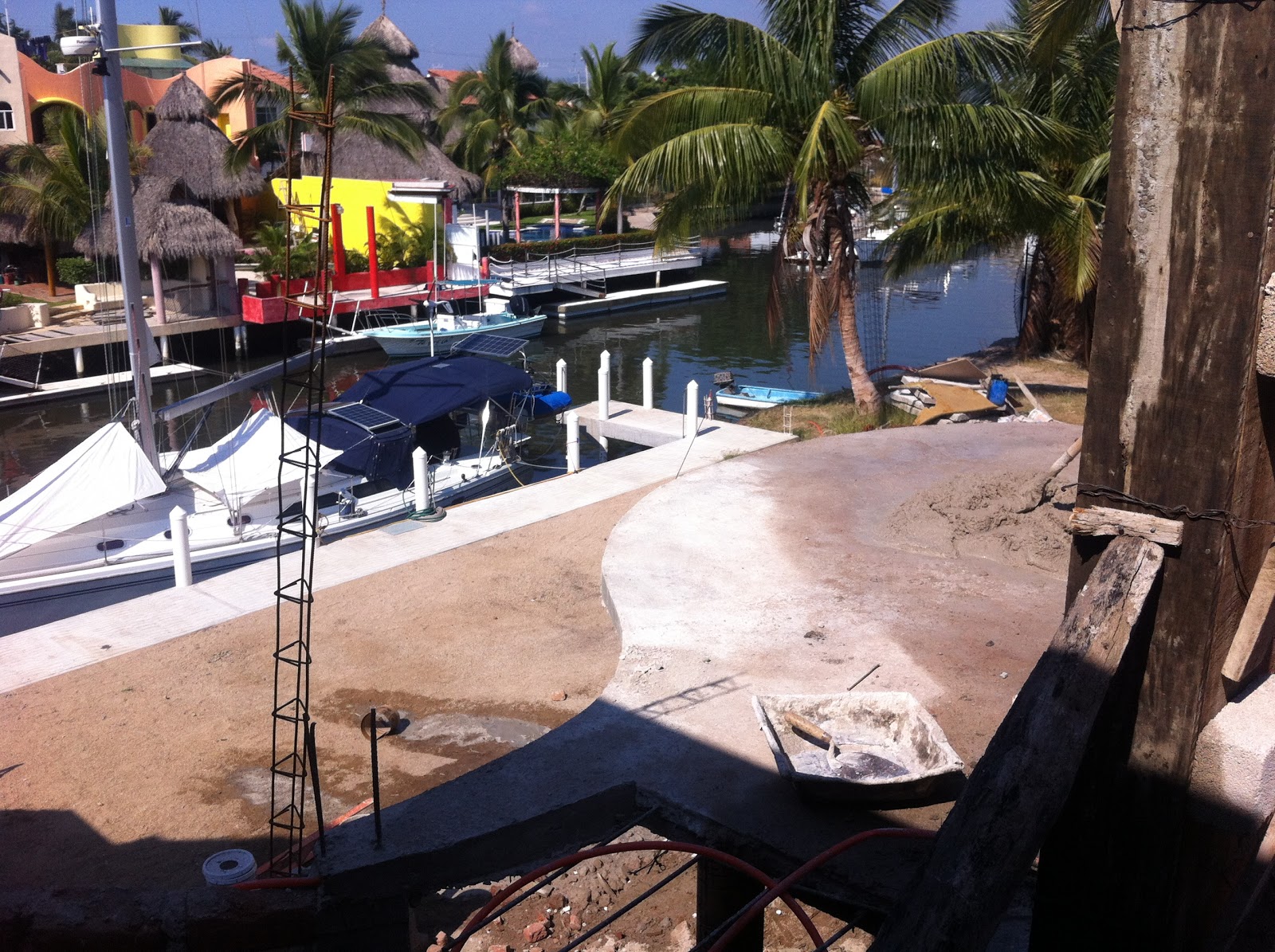
The first floor begins to take shape. On the right is the garage. TV room in the center. Kitchen at back.

Ingenious method to hold the pillar forms in place.


Cardboard tubes are placed over the steel rebar before they are filled with concrete. These will be the pillars that hold up the palapa.

The kitchen wall. A reinforced concrete lintel runs around the entire floor to provide support for doors and windows.

Looking through the hallway out the front door.


The forms are in place to pour the first floor.


Palapa and balcony pillars in place


Master bedroom balcony forms


The forms are ready on the first floor ready to add the steel mesh

The opening for the spiral staircase


Tying the rebar mesh together. Note the conduit to the light fittings.


All the wiring and piping in place before the floor is poured


First floor complete


Concrete is dry, so start on the 2nd floor walls


Very few machines, everything is done by hand and using locally available materials


I fly down in late November to check on the progress. There are already 4 yachts anchored in the lagoon.


Front of house. Office above garage on left. Kids bedrooms above kitchen on right


View of boat/canal from master bedroom shower.

Hallway to entrance. Kitchen on left


Spiral staircase from hallway. Entrance to garage on right.


Upstairs office/guest bedroom and balcony


2 tons of blocks and a 55 gallon drum full of water on the upstairs floor 10 days after it was poured. I'm not worried about it being strong enough now.


The palapa area and the master bedroom balcony take shape


Overlooking the marina from the master bedroom balcony


My neighbor dropped by after he caught this 100lb yellowfin tuna. He spared me a slice for dinner.


Checking the Jeep will fit in the garage. Should be enough length to fit 2 cars or the Jeep and a small boat.


A thin concrete coat is rendered on the walls. 4 coats will be applied in total. The final finish will be smooth and flat.


The 2nd floor walls in our master bedroom are almost complete.


The roof is nearly ready to pour. All in under 3 months.

The lower walls after 2 of 4 coats of concrete.

Saturday, October 1, 2011

Barra de Navidad (House Building 1)

I had dreamed about getting a vacation home somewhere warm to spend the winters. I had the opportunity to visit many towns on this sailing trip (over 73!) and since I had the time, pretty much every place I visited I looked into the real-estate market to find out what was possible.

Here's how my search progressed ....

Santa Barbara/Newport Beach/San Diego etc. I already own a house in Northern California and it may seem normal to people who live there, but the property taxes are ridiculous compared to the rest of the world. This really soured the thought of buying a second home in Southern California. Even if you buy an overpriced house on the water outright in California, the yearly property taxes are enough to buy a house in Mexico, every year! Also its not much warmer in SoCal in the winter. I can do better.

2 harbors Catalina, Southern California. Cant build here.

The Western Baja coast was too remote although I liked Turtle bay. Its also very cold in the winter.

Anchored all alone in the San Benito Islands. Absolutely no facilities!

Cabo San Lucas and the surrounding area is not true Mexico but an area we named "Gringo Landia". Its so touristy and full of pushy gift salesman that it virtually killed all the Mexican charm other areas are known for. Its strictly for rushed weekend trips.
 Cabo San Lucas, no waterfront properties, very commercialized.

La Paz was worth considering. Its a tourist town, but mainly for Mexicans. It has a good selection of stores, near an airport and has great boating facilities. The nearby islands and bays are fantastic and only a few hours away. The main issue was finding a plot of land on the water where I could securely keep my boat year round. A second issue is that come Xmas and the new year it gets cold in the evening. Thats why most cruisers have headed to Puerto Vallarta in Banderas bay by the New Year.

The Malecon at La Paz, Baja

La Cruz in Banderas Bay was another lovely town. They have recently constructed a big modern marina and I really took to the charm of the village. It has a great cruiser community and easy access to an airport (PVR) to get home. La Cruz was on my short list.

For Xmas we spent some time tied up at the Marina at Nuevo Vallarta. This is a nice facility with big hotels but it again fell into the trap of "Gringo Landia" with its McDonalds, Starbucks etc and very little Mexican charm. This was the first location where you could buy some land directly on the canal system and have the boat in your back garden. Association fees for owning a house in the 'compound' where also at California levels.

The Marina in Puerto Vallarta had huge apartment blocks surrounding the docks but again very little Mexican atmosphere and no privacy

Other towns I visited between PV and Barra either had very weak boating facilities or where just too remote to access on a regular basis. You need a nearby international airport and good roads to your town as you will be visiting often if things go right.

Barra de Navidad as seen from Isla Navidad

When I pulled into Barra I soon discovered that the lagoon was the best anchorage I had stayed in on my whole trip. No swell and easy access to the town via taxi pangas or your own dinghy. There was no charge to anchor out and no time limit to how long you can stay.

During the Season, Dec-Apr a large number of cruisers from around the world stop here and it makes for a cool boating atmosphere. The town of full of Yachties and there is always something to do.

After I had been anchored in the lagoon for a few weeks I discovered the canal system. It was dredged out of the mangrove swamps in the 60's. The original inhabitants were moved to the area now known as the Bario in East Barra.
Aerial shot of Barra during construction of the canal system in the 60's?

A large part of the canal was reserved for the Cabo Blanco hotel which the whole area is now named after. It is not actually part of Barra but a seperate development owned by the family that owns the Grand Bay hotel (Leano Family?)

Cabo Blanco in 2007. The rate of development has been furious. Most of the empty lots are now built on.

The whole grass area left of the center canal was reserved for expansion of the Cabo Blanco hotel. The hotel is the S shaped building at bottom left. The Green area at the bottom right (below marina on center canal) was also reserved for a park, but has since been sold as lots.
The brown island just above the canals in the center of the picture above is Punta Vela. This is still undeveloped but has just been approved to sell as 26 individual lots (Dec 2011). The ownership was under dispute with the Mexican Navy (I was told) until now. It is planned to be a gated community and have its own marina (at right of island).

The lot we ended up buying on the center Canal

Once I had the idea that Barra could be a great place for our winter home and a mooring for our boat year round I started looking at all the available properties. Being able to have the boat tied up on your own land is a fantastic opportunity as in California owning a boat is very expensive with the property taxes and mooring fees you must pay. Property taxes and association fees for being on the canal for 1 year were less than I pay for one day in California!
If I could buy land with Canal access I could build a dock and potentially keep the boat in a secure area with water and electricity. The cost of the dock would pay for itself in a few years and I would have my boat in my back garden. My dream come true.
I especially liked the lot we chose as its opposite the Cabo Blanco hotel with 24 hour security and a guard gate at the start of our road. The road is a dead end so it *should* be safe when I leave the boat for the summer. So far no problems!
The previous owner of the property we bought also sold me his Jeep. Its been great fun.
Driving the Jeep in the local Jungle. You need the 4x4 option regularly

One attractive part about Barra and Cabo Blanco is that any potential owner can buy title to the property. Much property in Mexico is community owned and you must lease it thro the Ejido. Ejido land is potentially troublesome as you only have a contract with the local town over ownership. See the problems at  nearby Tenacatita for an example of how Ejido land can lead to ownership disputes.

All titled property within 50 miles of the coast has to be purchased thro a bank trust. All property purchased in the Barra area usually is transferred using the Notary Public Narciso P. Lomeli in Cihuatlan. He brings the 2 parties together (buyer/seller) and makes out a contract. He advises when to transfer funds and organizes the bank trust. The whole process takes around 3 months. Our land was previously owned by an American citizen so we wired the money within the USA to do the purchase.

One of Lomeli's many certificates in his office

Read my blog about building our dock here

Building the dock first allowed me to experiment with the Mexican building process on a smaller scale before embarking on the large house project. It definitely taught me a few lessons about patience and expectations.
The completed dock and Sea42 tied up at her new home.

The center canal was my preferred canal for a number of reasons. It had the most depth. It was the widest. It had the best security. It had the slowest traffic. It had the nicest homes. Having the small marina at the end ensured it should be reasonably maintained.
Building in Mexico turned out to be a very similar process to building in the UK and the USA, There is a common misconception that in Mexico you can build what ever you like from corrugated sheets and a few planks, but if you follow the law it involves contracts, city permits, plans, engineering drawings, soil samples and liability insurance for your workers. Of course it is more flexible than the California, but then I need a permit to change a light bulb in CA!

One big difference to construction is that homes are built from steel reinforced concrete and not 2x4 sticks like California. This allows a huge flexibility in the design of the house. I did notice that while private homes in California are built from wood, government buildings and offices are made with concrete and steel.